Do You Really Know Yourself? The Fascinating Science Behind How Psychologists Uncover Your True Personality
We’ve all done it—scrolled through social media and paused to take a quiz telling us which fictional character we are or what our coffee order says about our soul. While these are fun, the actual science of measuring personality is far more intricate and fascinating. It’s a field that has evolved from ancient superstitions to sophisticated psychological tools designed to unlock the mysteries of the human mind.
Chiranjit Chakraborty
12/25/20253 min read

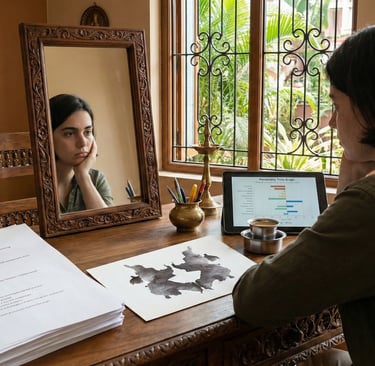
Behind the scenes, the assessment of personality is a rigorous blend of art and science that has evolved from ancient theories to complex modern tools. It is not just about labelling you; it is about quantifying the intricate, invisible patterns of behaviour that make you unique. In this article, we will peel back the layers of psychological testing to explore the fascinating history, the strict rules of the game, and the clever methods—from inkblots to questionnaires—that psychologists use to unlock the mysteries of the human mind.
From Body Fluids to Data
The journey of personality testing began long before computers or questionnaires. Ancient Greek physicians like Hippocrates and Galen believed that our personalities were ruled by our body fluids, or "humours." If you were cheerful, you had too much blood; if you were sluggish, you had too much phlegm
Thankfully, science moved on. By the early 20th century, the focus shifted to standardized measurement. During World War I, the first personality inventory—the Woodworth Personal Data Sheet—was created to screen soldiers for "shell shock." Later, during World War II, the Office of Strategic Services (the precursor to the CIA) used intense stress interviews to select spies, laying the groundwork for modern assessment centres
The Rules of the Game
For a personality test to be considered valid in the scientific world, it can't just be a random collection of questions. It has to pass strict technical standards. First, it must be standardized, meaning everyone takes it under the exact same conditions
More importantly, a test needs to be both reliable and valid. Reliability asks, "Is this consistent?"—if you take the test today and again next month, you should get roughly the same result. Validity asks, "Is this accurate?"—does a test for shyness actually measure social anxiety, or does it just measure how much you prefer reading books? Without these two pillars, a test is essentially useless
The "Ask" Method: Self-Report Inventories
The most common way psychologists assess personality is simply by asking. Tools like the MMPI (Minnesota Multiphasic Personality Inventory) or the NEO-PI are comprehensive questionnaires used to diagnose disorders or map out personality traits like extroversion and agreeableness
However, this method has a flaw: human nature. We often try to make ourselves look better than we are, a phenomenon known as "social desirability." To combat this, test creators use clever tricks like "forced-choice" questions, where you have to pick between two equally good (or bad) options. Some tests even have built-in "lie detector" scales to flag if someone is faking their answers
The "Reveal" Method: Projective Techniques
Sometimes, direct questions don't work. We might be hiding our true feelings or simply be unaware of them. This is where projective tests come in. The idea is based on the Projective Hypothesis: if you show someone an ambiguous image, their mind will fill in the blanks with their own unconscious needs and conflicts.
The most famous example is the Rorschach Inkblot Test. When you describe what you see in a random ink splatter, you aren't just identifying a shape; you are revealing how your brain organizes information. Similarly, the Thematic Apperception Test (TAT) asks people to tell a story about a picture. Who is the hero? What are they fighting against? The stories we tell often mirror the battles we are fighting in our own lives
Watching What We Do
Finally, some psychologists prefer to step back and observe. Behavioural assessment ignores internal traits and looks strictly at actions. By analysing what happens before a behaviour triggers it and what happens afterward to reinforce it, psychologists can understand why we do what we do. It’s a practical approach that reminds us that personality isn't just what we think—it's how we act.
Personality assessment is a blend of art and science. Whether through careful observation, complex questionnaires, or interpreting inkblots, the goal remains the same: to understand the unique combination of traits that makes you, you.